



Farap-Ashgabat 3 Days 2 Nights Tour
.jpg)
About tour
A 3-day, 2-night tour from Farap to Merv and Ashgabat is a popular itinerary for travelers entering Turkmenistan from Uzbekistan. Tour Highlights Ancient Merv: Explore the ruins of Merv, a UNESCO World Heritage site and a major hub on the Silk Road. You'll see the remains of various settlements that co-existed over centuries, including the Mausoleum of Sultan Sanjar, the Great and Small Gyz Kala, and Erk Kala. Ashgabat, the "White Marble City": Discover Turkmenistan's capital, a city renowned for its grand, white marble buildings and golden monuments. A city tour typically includes sights like the Monument of Neutrality, Independence Park, and the Ertugrul Gazi Mosque.
Itinerary
-
Our representative will meet you at the Turkmen/Uzbek, Alat/Farap border. Drive to Mary: Once clear, you embark on the journey toward Mary.
You'll pass through Turkmenabat (the administrative center of Lebap Province). En route stop at some typical dunes of Garagum Desert to enjoy with photos.
Ancient Merv was the most important Silk Road hub in the region, and particularly thriving as regional capital under Seljuk governor Sanjar. Merw is the collective name of five urban centers that existed under various different names in different periods from the VI c BC up to the XVIII c AD.Today, Merv occupies a territory of more than 1200 ha and forms the biggest archeological site in Central Asia. The importance of the site was recognized in 1999 by UNESCO, which awarded Merv World Heritage status.
The Seljuk capital, consisting of a shahristan (medieval citadel) and a rabat(outskirts of the medieval city), considerably exceeded Damascus and Jerusalem in size. Today the Seljuk citadel is called SultanKala. It has an oval shape and occupies about 630 hectares. Its layout is still visible in aerial pictures. Among all city sites of Merw, perhaps the most significant is the medieval Seljuk city.
Soltan Sanjar Mausoleum most majestic architectural monument of Merv is Sultan Sanjar mausoleum called "Dar-al-Akhir" ("Otherworld"). His whole appearance it represents the highest achievements and flourishing Seljuk power. Sultan Sanjar Mausoleum is located in the center of the settlement Sultan Kala. Nearby are large monumental buildings - the palaces of Seljuk rulers and a mosque.
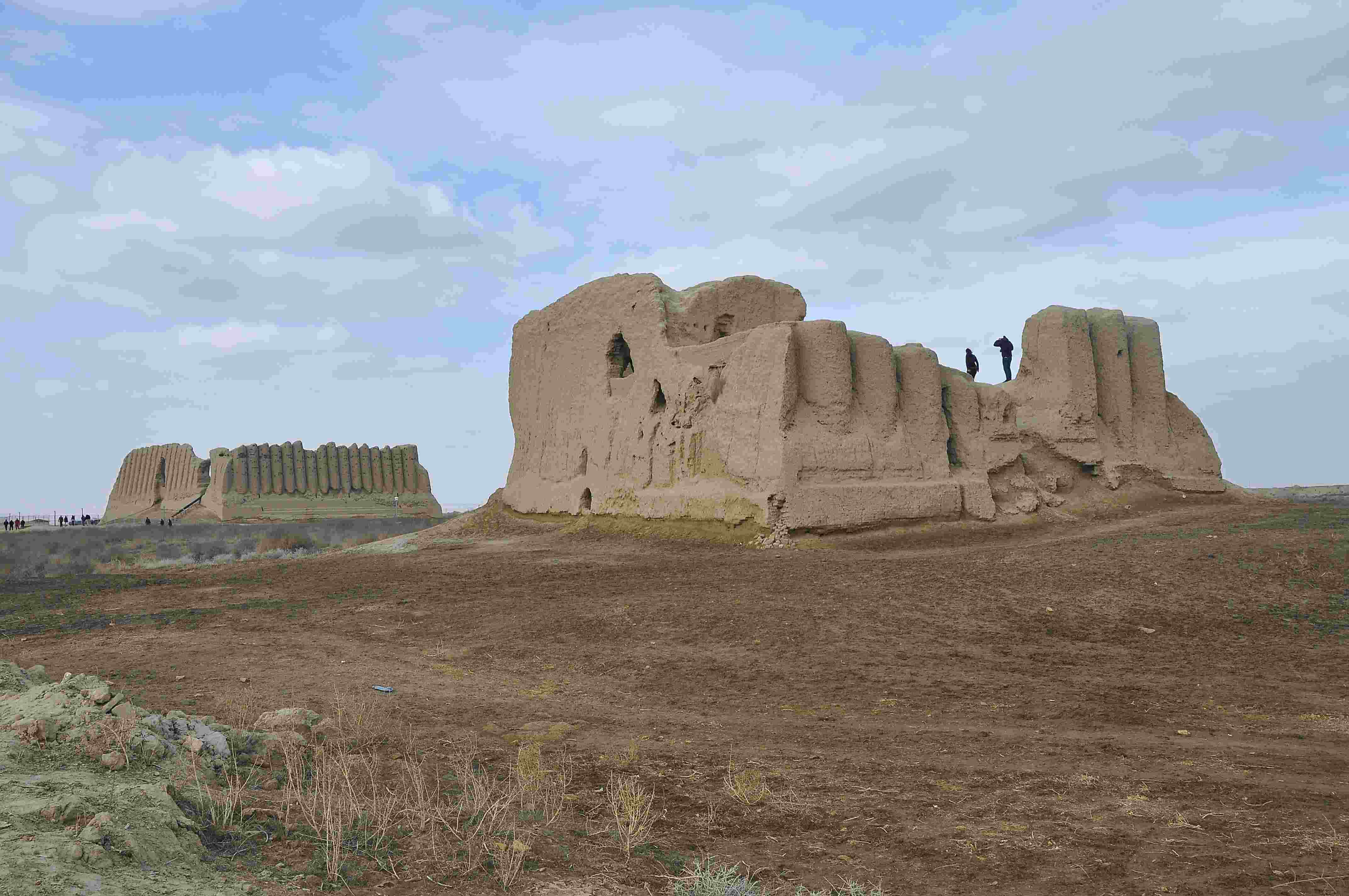
Great and Less Kiz fortress small fortresses with corrugated, if folded in the crease, napodobye accordion, walls. They put on the earthen ramps with mild slope. Small windows are hidden in the folds of the walls. At the top of the wall terminate toothed battlements, which are almost did not survive.
Mausoleums of ashkhabs. Original set of graves from the time of the Arab invasioninto Central Asia in the early years after the death of Mohamed. The graves of two askhabs(companions/campaigners of the Prophet) are of Al KhakamGifari (died in 670) and Bureyda Al Aslami (died in 681).
Gyaur Kala fortress In Turkic languages, "Gyaur" means "infidel", referring to those who do not practise Islam. The name of the fortress in ancient Merv, Gyaur-Kala - "Fortress of the Infidels" - was given by the Arabs who conquered it in the early 8th century. However, the fortress itself dates back much earlier, to the 4th-3rd centuries BC.
Erk-Kala fortress was the center of ancient Merv. The fortifications of Erk-Kala have sagged under earth drifts but nevertheless, have preserved their height and power. This distinguishes Erk-Kala from other fortresses. Now the height of the fortifications with steep slopes and precisely cut out towers reaches 25 - 29 m.
Ice houses (approximately XV c., Timurid rule)are visible from the road between the medieval and ancient cities of Merv. An extraordinary conical clay construction, built directly on the ground to store tightly packed snow. The original height is hard to determine.
The mausoleum-complex of Hodja Yusuf Hamadani (Hamdani) includes a modern mosque and minaret, the grave and mausoleum of Hodja Yusuf Hamadani (died in 1140), a Timuridiwan(portal) and a prayer hall. It is located not far from the Seljuk citadel. This complex has been largely reconstructed and turned into an important pilgrimage site. Hodja Yusuf Hamadani was a famous Sufi scholar of the 12th century, and the first of a group of Central Asian Sufi teachers who founded the Naqshbandi order. He was born in 1048-49 in a small settlement called Bezendjird, close to the famous Iranian city of Hamadan, when Merw was under Seljuk rule.
Shahriar Ark was constructed - a citadel within the citadel, protected by its own walls and moat. Visiting Shahriar Ark you can see the Kepter Khana- an interesting corrugated structure, which is the best-preserved in the citadel. It’s walls still survive to a height of some 4,5 m, however the original height of the walls is hard to determine.
Mohamed ibn Zaid, dated by inscription to 1112-13. It is located outside the medieval Seljuk citadel. It is unclear as to whom the mausoleum is actually devoted to. The local legend speaks about Mohamed Said ibnZeidibn Ali ZeinalAbedonibn al- Huseinibn Ali-Talib, who was a prominent Shia teacher and direct descendant of the Prophet Ali in fifth generation.
Abdulla khan Kala, constructed in the time of Timurid rule in the region, and was enclosed by massive walls and a moat with massive ramparts. Although one of the strongest and best fortified cities in the area, Abdullakhan Kala never reached the importance of the previous city sites. The remains of the city walls are still impressive, however, the walls, the Timurid palace and other constructions in this citadel, as well as four gates were much better preserved in the 19th century.
If have time short walking tour within the central part of Mary City which has The Regional Mosque of Mary Province, The Central Theater of Mary, The Convention & Conference Center “Ruhiyet Koshgi”, Central Park & Monument of Mollanepes-the National Classic Poet who lived in Mary in XVIII-XIXcc.
Night at the hotel.
-
BREAKFAST
Transfer to Mary airport
08:10 - Flight to Ashgabat
08:50 - Arrival in Ashgabat
We will begin our tour in Ashgabat. Ashgabat is a relatively young city in 25.05.2013 city was included Gunnies Book of records as a white marbled city on the world.
10:00 – Ashgabat sightseeing:
The State Museum of the State Cultural Center of Turkmenistan is the first and largest one of the 26 museums established following the independence of Turkmenistan. The official opening took place on 12 November 1998. It is located on Archabil Avenue in the picturesque Kopet Dagh foothills. Opposite the museum there is the main flag of Turkmenistan attached to one of the highest flagpole in the world.
Independence Park if you once find yourself in Ashgabat, the city of love, white marble and thousands of fountains, you must visit the main park in the Turkmen capital - National Independence Park. This Park is one of the city’s attractions, embodying the spirit of modern Turkmenistan.
Arch of Neutrality used to stand on the main square of the country, but in 2011, was moved to Ashgabat’s outskirts. Still worth a visit, this multi-level structure is crowned by a sculpture of the former Turkmenistan´s President, Saparmurat Niyazov. Previously, the sculpture used to rotate after the sun, making a daily full turnover.
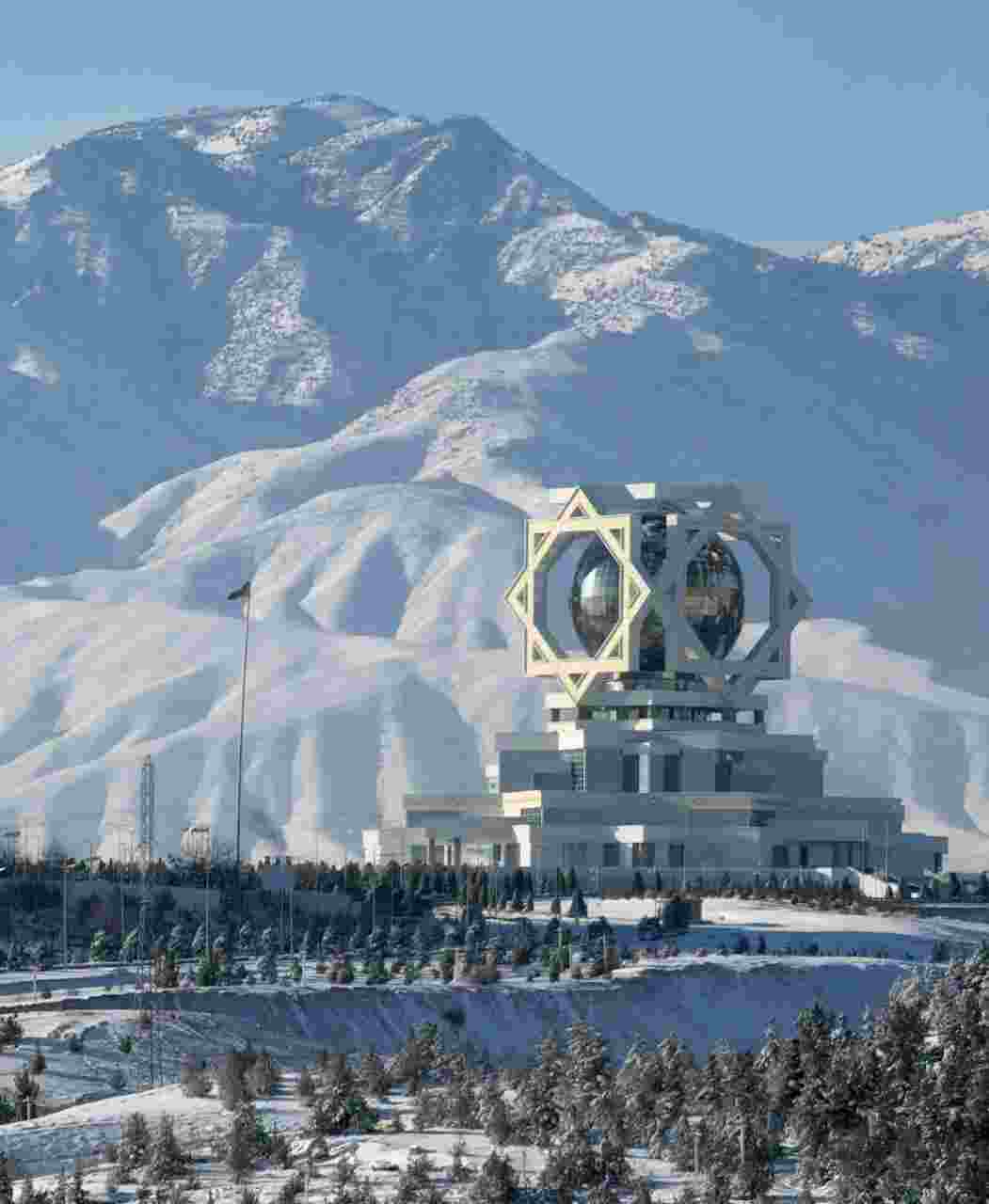
The Hotel “Bagt Koshgi” that from Turkmen language means “The temple of Happiness” is a part of a Wedding Palace with the same name located in 5 km from the centre of Ashgabat. This unique building of an unusual shape was opened in 2011 and besides the hotel includes six luxurious halls for marriage registrations, seven banquet halls, numerous shops and other different facilities necessary for wedding arrangement such as beauty salons, wedding dress boutiques, photo booths, and many others. “Bagt Koshgi “complex is an 11-storey building consisting of solid foundation on which a cube with octagonal sides stands, and this unusual figure can hold inside a huge ball with a diameter of 32 meters.
The Ferris Wheel in Ashgabat, known as the Giant Wheel, is an iconic landmark that complements the city’s modern skyline. From a height of about 40 metres, it offers a stunning panoramic view of Ashgabat and the surrounding landscape. Located in the heart of the city centre, the Ferris wheel is part of the large ‘Independence Park’, which features beautifully landscaped gardens, fountains and various recreational facilities. The giant wheel is particularly enchanting at night when it is lit up with multi-coloured lights, creating a vibrant atmosphere. It is an ideal place for families, couples and anyone who wants to admire the breathtaking views of Ashgabat, especially at sunset. This attraction symbolizes the rapid development of Turkmenistan‘s capital city and its desire for modernity, and provides a fun and enjoyable experience for all ages.
Night at the hotel.
-
Transfer to the Ashgabat International Airport for flight to next destination.
We hope you enjoyed our service and hope you'll come back again.
Customer Support
We have a professional customer support team and always accompany you on every trip.