



Turkmenistan / Uzbekistan / Kyrgyzstan -Silk Road Tour
About tour
A classic Silk Road trip through Turkmenistan, Uzbekistan, and Kyrgyzstan combines ancient caravan cities, desert landscapes, Soviet-era contrasts, and mountain nomadic culture. Here are the major highlights most travelers focus on:Ashgabat The surreal capital city — famous for white marble buildings, giant monuments, empty boulevards, and eccentric architecture. Key sights: Neutrality Monument Independence Park Wedding Palace Turkmen Carpet Museum Russian Bazaar Darvaza Gas Crater (“Door to Hell”) One of Central Asia’s most iconic sights: a massive burning gas crater in the desert. Best experienced overnight in a yurt or desert camp under the stars. Merv Ancient Silk Road oasis city and UNESCO World Heritage Site. Once one of the world’s largest cities during the Islamic Golden Age. Kunya-Urgench Ruins of a medieval capital with impressive minarets and mausoleums. Samarkand The jewel of the Silk Road. Stunning Timurid architecture and blue-tiled monuments: Registan Square Shah-i-Zinda necropolis Gur-e-Amir Mausoleum Bibi-Khanym Mosque Bukhara Best-preserved Silk Road old town in Central Asia. Highlights: Ark Fortress Poi-Kalyan complex Trading domes Traditional hammams Atmospheric evening walks in the old city Khiva A compact walled desert city that feels like an open-air museum. Itchan Kala old town Kalta Minor Minaret Sunset from the city walls Tashkent Modern capital mixing Soviet architecture and Islamic heritage. Metro stations Chorsu Bazaar Applied Arts Museum Shahrisabz Birthplace of Timur (Tamerlane), with monumental ruins and restored plazas. Bishkek Leafy Soviet-style capital with mountain views. Ala-Too Square Osh Bazaar Soviet mosaics and cafés Issyk-Kul Huge alpine lake surrounded by mountains. Popular activities: Beaches Horse trekking Eagle hunting demonstrations Yurt stays Song-Kul Classic nomadic highland experience: Horse riding Staying with shepherd families Wide-open steppe scenery Jeti-Oguz Red rock formations and alpine valleys near Karakol. Karakol Adventure hub with: Trekking Dungan Mosque Russian Orthodox Cathedral Access to Tian Shan mountains Ala-Kul Lake One of Central Asia’s most spectacular multi-day hikes.
Itinerary
-
Early morning arrival to Ashgabat International airport by Turkish Airlines.
Tour guide will meet you and transfer to the hotel.
Upon arrival check-in and overnight at the hotel.
-
After breakfast we will begin our tour in Ashgabat.
Ashgabat is a relatively young city in 25.05.2013 city was included Gunnies Book of records as a white marbled city on the world.
09:30 – Ashgabat sightseeing:
The State Museum of the State Cultural Center of Turkmenistan is the first and largest one of the 26 museums established following the independence of Turkmenistan. The official opening took place on 12 November 1998. It is located on Archabil Avenue in the picturesque Kopet Dagh foothills. Opposite the museum there is the main flag of Turkmenistan attached to one of the highest flagpole in the world. After the tour, transfer to your hotel and enjoy a relaxing evening in this enchanting city.
Independence Park if you once find yourself in Ashgabat, the city of love, white marble and thousands of fountains, you must visit the main park in the Turkmen capital - National Independence Park. This Park is one of the city’s attractions, embodying the spirit of modern Turkmenistan.
Arch of Neutrality used to stand on the main square of the country, but in 2011, was moved to Ashgabat’s outskirts. Still worth a visit, this multi-level structure is crowned by a sculpture of the former Turkmenistan´s President, Saparmurat Niyazov. Previously, the sculpture used to rotate after the sun, making a daily full turnover.
Ertugrul Gazi Mosque is one of the most beautiful Muslim mosques of Turkmenistan. Like any other buildings, erected in Ashgabat during the period of independence, the mosque strikes with its size and rich decoration. The mosque was erected in the heart of Ashgabat, in Azadi street in the 90-s of the XX century. That is why this building is also called the Azadi Mosque.
Meals: Breakfast/Lunch/Dinner
-
09:00 – After breakfast visits:
The Turkmenbashi Ruhy Mosque eleven kilometers to the west of Ashgabat there stands one of the largest mosques in Central Asia and main mosque of Turkmenistan – The Turkmenbashi Ruhy Mosque. Like all other buildings of the period of independence it differs with its immensity and grandiosity.
Old and New Nisa 18 km from the city of Ashgabat in the outskirts of Bagir village there is a unique ancient monument, the ruins of ancient settlement Nisa. It used to be the capital of Parthia which had existed from the third century B.C. to the third century A.D. The Historical complex includes two archeologic monuments - Old and New Nisa.
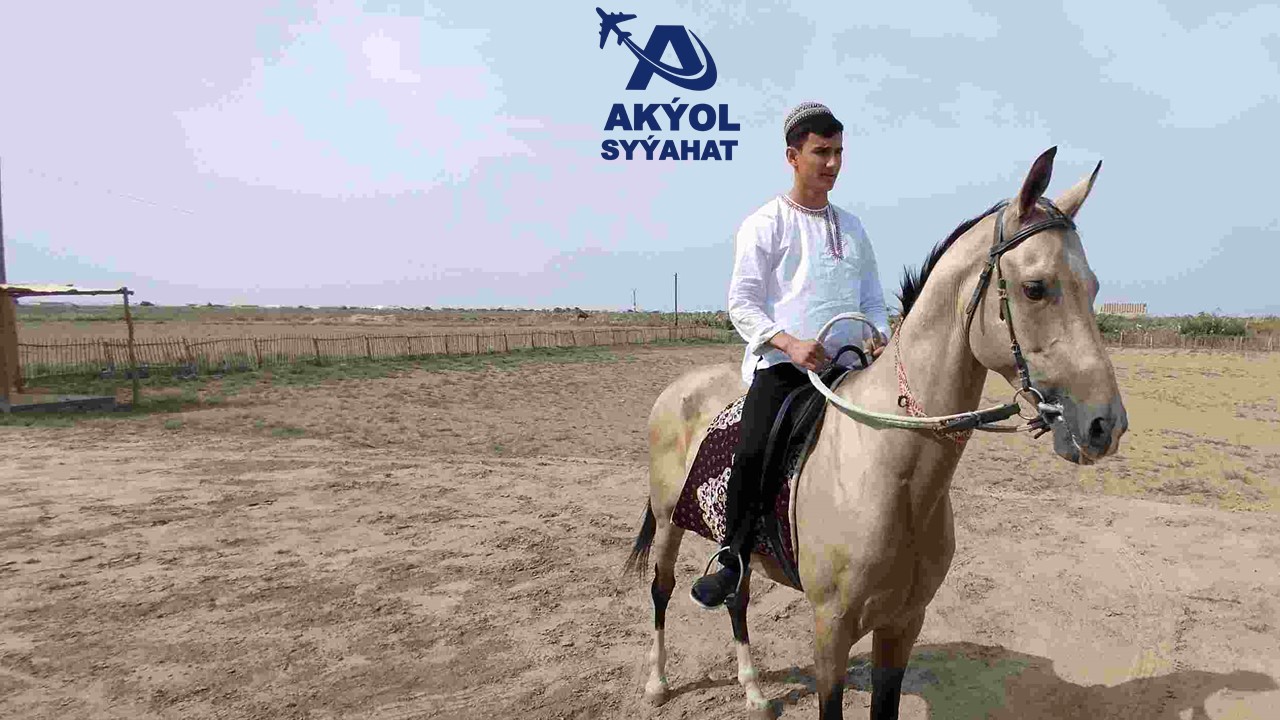
Akhalteke Horse Farm the horse farm is located in the countryside area, behind the GeokDepe town, 55km. Excursion at the farm to see the AkhalTeke horse and Turkmen dog Alabay. Akhal-Teke horse farm – home to the world-famous Turkmen horses. Learn about the breeding traditions and history of Akhal-Teke horses. Here, experts will tell you about Akhal-Teke horses. Next to the farm, you can take a horseback ride through the gardens.
Underground lake Kov-Ata, located 107 km from Ashgabat.The Turkmen name Kov-Ata means Father of Caves. At first glance, this underground space looks like a magnificent auditorium: the total length of the cave is 230 m, the height reaches 20 m, and the width in some places reaches 57 m.The bottom of the cave is covered with lumps of dissolved limestone (stalagmites), and the warm, gushing water is clear and emerald in color. The water has a constant temperature of 33-37°C. (You should take a swim in the lake). After the tour, transfer to your hotel.
Overnight stay in a hotel in Ashgabat
Meals: Breakfast/Lunch/Dinner
-
Today after breakfast drive to Mary Region. On the way visits:
Seyitjemaleddin Mosque located in the city of Anau, 12 km east of Ashgabat along the Ashgabat-Mary highway. The Seyit-Jemallidin Mosque is a complex structure that once included a mosque, madrasah and the mausoleum of Sheikh Jemal ad-Din.On the Turkmen land the famous Seyit-Jemallidin mosque, widely known as “Seyit-Jemal ad-Din”, a well-known monument that preserves the unique architectural traditions and artistic styles of the Iron Age. The monument was built in the 15th century during the reign of Abul Qasim Babur, a Timurid descendant in Khorasan. This mosque amazed many Muslim architects of the East with its external beauty and architectural features.
Abiverd one of the most important cities of Northern Khorasan is a medieval settlement Abiverd. Hafiz-i-Abru said that Abiverd settlement consisted of dozens of villages and several cities. The city wall is a rectangular area of 42 hectares.There also were found ancient coins, ceramics products of IX-XII centuries, as well as a lot of metal handicrafts: various women's jewelries, buckles. According by them, we can say that there were shops of jewelers and tinkers. During the excavation’s archeologists found huge wells and reservoirs, indicating a highly-developed irrigation of Abiverd. The first investigation was taking place in 1928 under the lidership A.A. Semenov, who first made a plan of the city, citadel and remains of the city wall. In addition to Semenov’s scientific works, there are also archeological materials collected by the members of the expedition from different parts of Abiverd.
Upon arrival accommodation & rest or (if have time) short walking tour within the central part of Mary City which has The Regional Mosque of Mary Province, The Central Theater of Mary, The Convention & Conference Center “Ruhiyet Koshgi”, Central Park & Monument of Mollanepes-the National Classic Poet who lived in Mary in XVIII-XIXcc.
Overnight stay in a hotel in Mary
Meals:Breakfast/Lunch/Dinner
-
09:00 – after breakfast drive to Old Merv. Located from Mary city 30 km
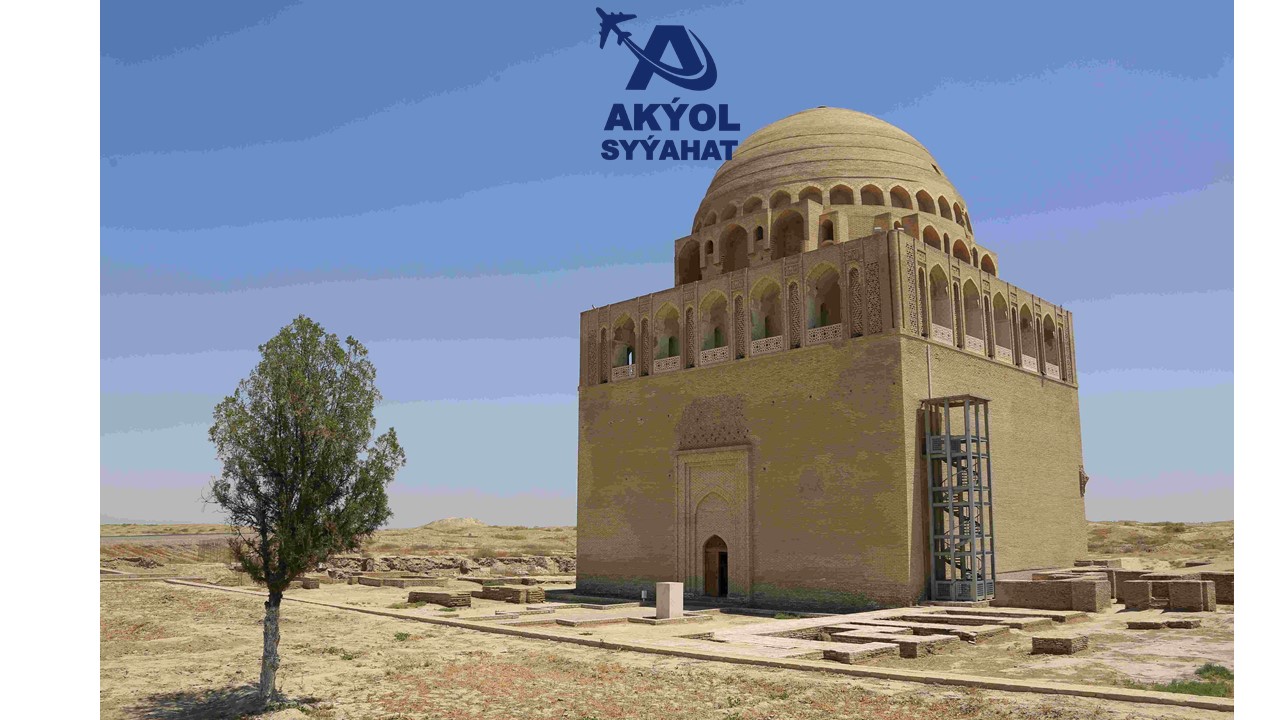
Old Merv was the most important Silk Road hub in the Region, and particularly thriving as regional capital under Seljuk Governor Soltan Sanjar. Old Merv is the collective name of five urban centers that existed under various different names in different periods from the VI c BC up to the XVIII c AD. Today Old Merv occupies a territory of more than 1200 ha and forms the biggest archeological site in Central Asia. The importance of the site was recognized in 1999 by UNESCO, which awarded Merv World Heritage status.
Soltan Sanjar Mausoleum most majestic architectural monument of Merv is Sultan Sanjar mausoleum called "Dar-al-Akhir" ("Otherworld"). His whole appearance it represents the highest achievements and flourishing Seljuk power. Sultan Sanjar Mausoleum is located in the center of the settlement Sultan Kala. Nearby are large monumental buildings - the palaces of Seljuk rulers and a mosque.
Great and Less Kiz fortress small fortresses with corrugated, if folded in the crease, napodobye accordion, walls. They put on the earthen ramps with mild slope. Small windows are hidden in the folds of the walls. At the top of the wall terminate toothed battlements, which are almost did not survive.
Gyaur Kala fortress In Turkic languages, "Gyaur" means "infidel", referring to those who do not practise Islam. The name of the fortress in ancient Merv, Gyaur-Kala - "Fortress of the Infidels" - was given by the Arabs who conquered it in the early 8th century. However, the fortress itself dates back much earlier, to the 4th-3rd centuries BC.
Erk-Kala fortress was the center of ancient Merv. The fortifications of Erk-Kala have sagged under earth drifts but nevertheless, have preserved their height and power. This distinguishes Erk-Kala from other fortresses. Now the height of the fortifications with steep slopes and precisely cut out towers reaches 25 - 29 m.
Yusuf Khamadany Mosque this complex was built on the burial site of Abu-Yakub Yusuf ibn Ayub born in the city of Hamadan (western Iran). Above his tomb the mausoleum, which has not survived, was erected. The destroyed structure was partially restored and reconstructed in the 19th century. The tomb of the dervish symbolizes a crypt from black marble decorated with a floral ornament and inscriptions. There is a chapel in the western corner of the mausoleum with central aivan. It is the basic part of the complex. Today Yusuf Khamadani mosque is an important Muslim temple, the place of worshipping.
Sultan Kala fortress in the 11th-12th centuries Merv became the capital of Great Seljuk state and reached the highest prosperity. By the order of Seljuk sultan Melik-shakh the city was surrounded by a fortification and moat.This fortress with the area of over 400 hectares is known as Sultan-Kala - the Fortress of Sultans. In the northeastern part of Sultan-Kala Shakhriar-ark citadel with palace complexes of sultans, administration buildings and a military barracks - was constructed.
History, Flora and Fauna of Mary Region in the Mary History Museum the Mary History Museum was established as the Mary Museum of History and Revolution in 1968. Its first exposition opened in 1974. When Turkmenistan gained independence, the Museum in 2008 moved into a new white-marbled building in the center of Mary.
Transfer to Mary Airport, then flight to Ashgabat (20:15-20:55)
Upon arrival in Ashgabat, then transfer to hotel.
Overnight stay in a hotel in Ashgabat
Meals:Breakfast/Lunch/Dinner
-
09:00 – after breakfast visit:
Halk Hakydasy memorial complex: located on a hill towering over the city, the Memorial Complex covers an area of 650 000 metres2. It includes the monument dedicated to World War II, the monuments to the heroes of World War II and the Battle of Gokdepe, and to the victims of the 1948 Ashgabat earthquake. The Complex has a museum and a building for sadaqa on Day of Remembrance. The majestic stairs with rest areas leads to the monuments. The hill, on which the complex is located, has been turned into a magnificent park (431 000 m2) with blue spruces, cypress trees, lawns, flower beds, fountains and gazebos. There are alleys with original lamps and benches in the park, where people spend a lot of time admiring the beauty of this place, the panorama of a modern city or the natural landscapes of the Kopetdag Mountains.
After lunch drive to Darvaza Gas crater (270 km, 4-5 hours drive).
The Darvaza gas crater also known as the Door to Hell or Gates of Hell, officially the Shining of Karakum, is a burning natural gas field collapsed into a cavern near Darvaza, Turkmenistan. Hundreds of natural gas fires illuminate the floor and rim of the crater. The crater has been burning since 1971. You'll find the Darvaza mud crater perched almost conveniently close to the main highway - a mere 200-metre stroll away. The sheer cliffs of this crater proudly display layers of limestone deposits, with a diameter stretching 70 meters and a depth of around 20 metres. A further 24 km southward lies the Darvaza water crater. Much like its mud sibling, this crater is conveniently accessible from the main road – just 150 meters off the beaten track. It stretches 50 meters wide with steep walls leading to a water-filled basin 15 meters below ground level.
Barbeque style dinner.
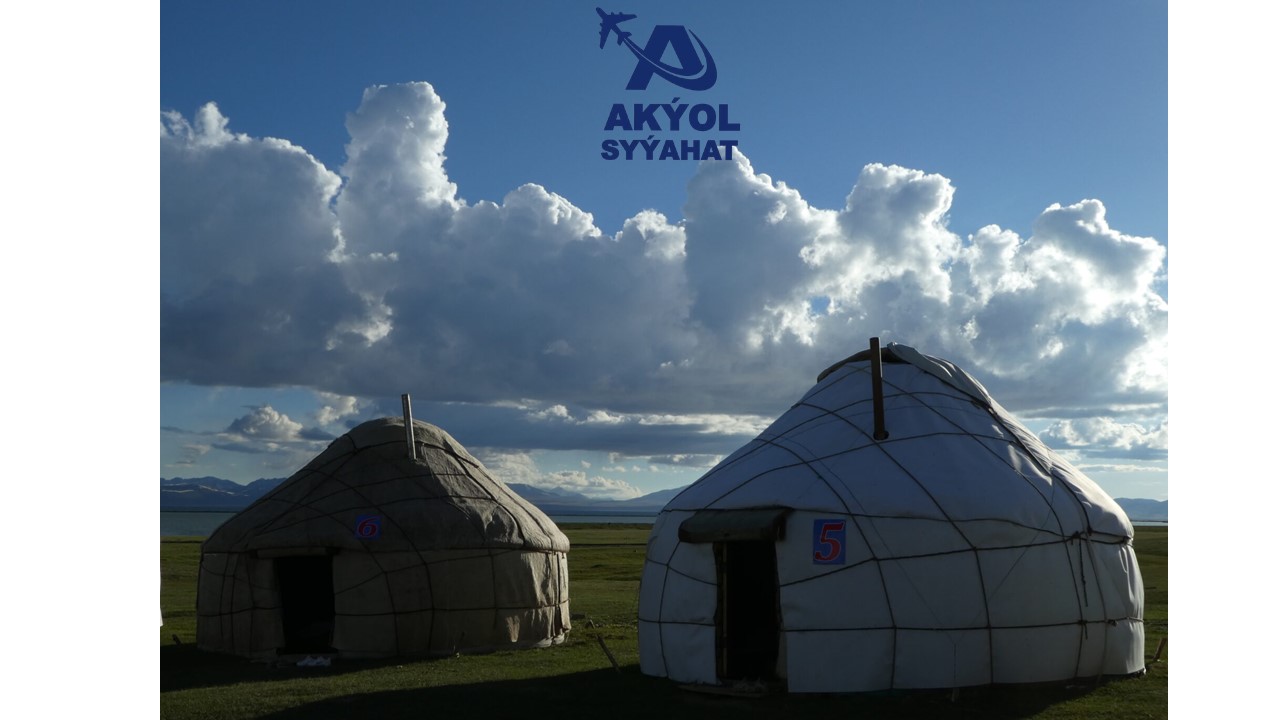
Overnight stay in traditional yurt
Meals: Breakfast/Lunch/BBQ Dinner
-
08:00 – After BBQ style breakfast departure to Kunya-Urgench historical site.
On the way stop take some photos Karakum Desert fauna and flora
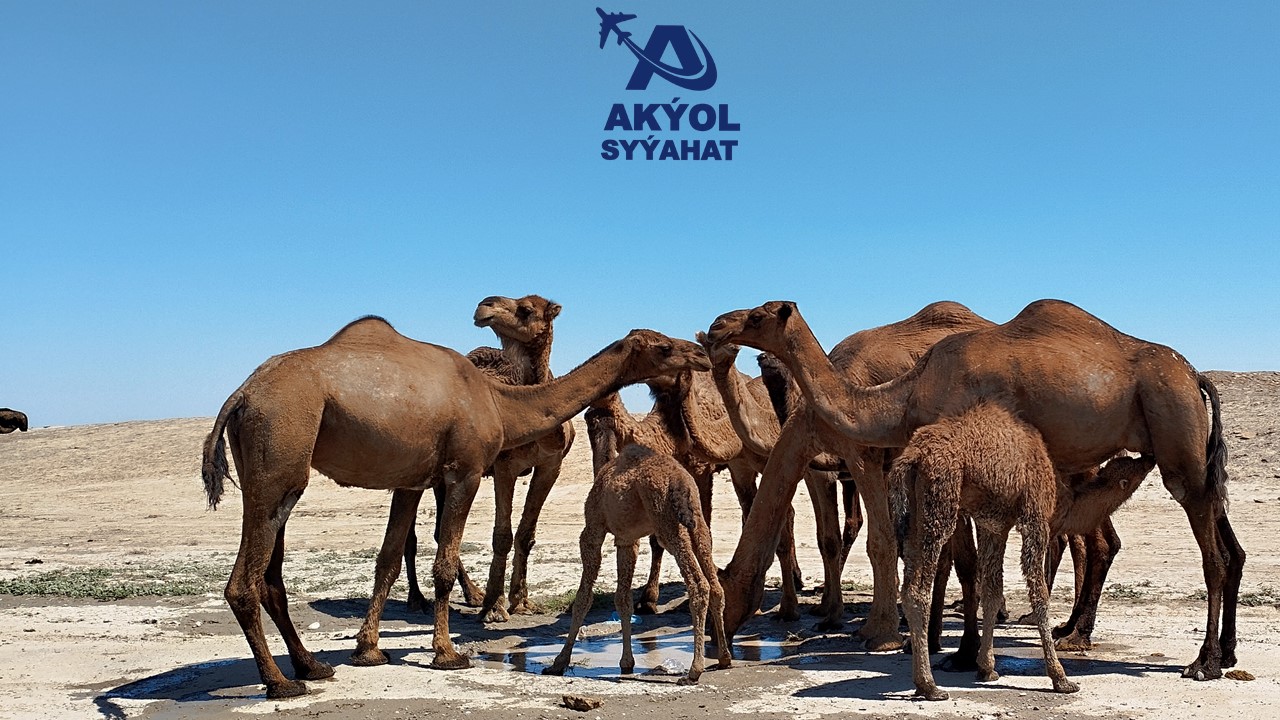
The Karakum is a sand desert stretching for 350,000 km2 from the Caspian Sea to Pamir foothills and from Amu Darya to Kopet Dag ridge. Its name is translated as “black sands” (“kara” - black, “kum” - sand). The dessert corresponds to its gloomy name, because some of its parts were previously completely waterless for hundreds of kilometers, and anyone who tried to cross it, found a terrible death under the scorching sun of Asia. Flora is represented by the sand sedge, acacia, saksaul, and in spring, by grasses and flowers which cover huge areas, except for dunes, and completely dry up by May. Fauna of the Karakum desert includes gazelles, foxes, wolves, various rodents, lizards, snakes and insects. Besides the wildlife, grassland farming to raise sheep and camels is also common there.
Kunya-Urgench (Keneurgench) is an ancient city, the first mention of which dates back to the III-I centuries BC. It is found even in the Avesta, the main book of the Zoroastrians. There the city is called Urva (Urga). Caravans of the Great Silk Road passed through here, and the Chinese called the city Yue-gan, although it was located on the territory of the state of Khorezm. Once the caravans of the Great Silk Road passed here. Today, several buildings of the XI-XVI centuries have been preserved in the city. After excursion drive to Dashoguz city . Check in hotel.
Overnight stay in a hotel in Dashoguz
Meals: BBQ style Breakfast/Lunch/Dinner
-
After breakfast, you will be transferred to the Dashoguz border (15 km, 25 min). Arrive at the Dashoguz/Shavat border, a crossing point complete all border formalities and meet your guide and driver. Welcome by our guide and driver Uzbekistan side
Then drive to Khiva (57 km/1.5 h), arrival and check-in at the hotel. Rest time.
In the afternoon we begin our visit to the museum-city of Khiva, once an important slave market in Central Asia.
Exploring the old town and its many 19th-century monuments:
Pakhlavan Mahmoud (Pahlavon Mahmud) the Hercules of the East, Palvan Pir the kurash wrestler-saint, Pirar Vali the antireligious Persian poet, Mahmoud the district furrier, all died here, one and the same, in 1325 to enter local folklore as a hero of both brain and brawn and to become the adopted patron saint of Khiva.;
This palace, which means ‘Stone House’, contains Khiva’s most sumptuous interior decoration, including ceramic tiles, carved stone and wood, and ghanch. Built by Allakuli Khan between 1832 and 1841 as a more splendid alternative to the Kuhna Ark, it’s said to have more than 150 rooms off nine courtyards, with high ceilings designed to catch any breeze.;
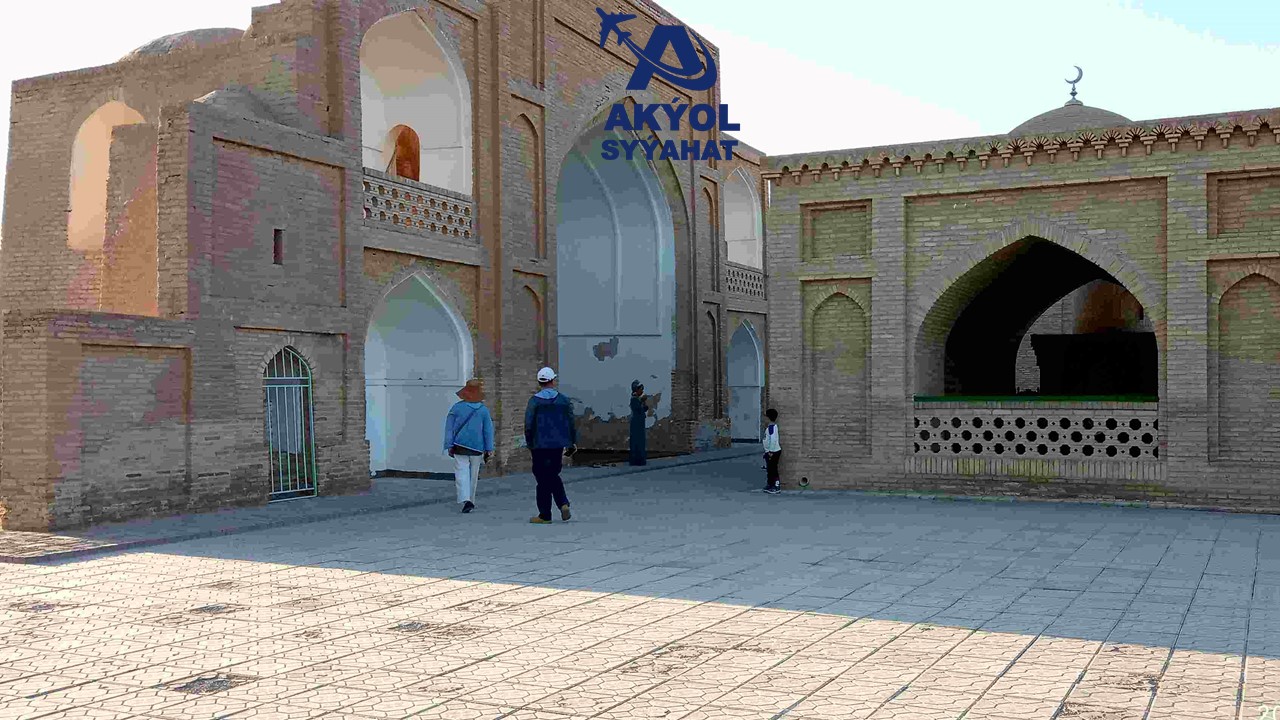
Muhammad Amin Madrasah was built in 1785 by the order of Mohammed Amin who was the first emir of Kungrat dynasty in Khiva. According to legend, in one of the rooms of the madrasah was burial Mohammed Amin or his younger son Qutlugh ball Murad Khan.;
Jum`a Mosque is a one-storey building with a flat roof which is maintained 213 columns mounted on a square grid of 3,15 x 3,15 meters. Mihrab of the mosque is in the center the south wall.;
Kunya-Ark Citadel, Khiva according to historical evidence, in 1686, Arang-khan began the construction of the citadel Kunya-ark at the western gates of Ichan-kala. The ark presented a complex multi-yard composition, containing a house for khan, the members of his family, and dignitaries.
Kalta Minor the main facade of the Muhammad Amin-khan madrasah has a massive low minaret. They were going to complete the main city area at the western Ichan-Kala gate with the minaret and madrasah construction. The minaret was intended to become the largest in Central Asia, had it been completed. The uncompleted minaret, with a base diameter of 14.2 m, should have been 70-80 m high according to its plan.
Overnight stay in a hotel Khiva.Meals: Breakfast/Lunch/Dinner
-
09:00 – after breakfast drive to the pre-Islamic citadel of Ayaz-Kala (3rd-2nd century BC – period of the Kushan Empire).
Ayaz-Kala or the fortress Ayaz-Kala fortress can be called as miracle of light and wind, located 20 kilometers north-east of Toprak- Kala in the moving sands of the Kyzyl-Kum and ridges of the sacred mountains of Sultan Uwais.This monument of our history is vast mound on a flat hill that emerged perhaps as early as the 4th century BC.
Ancient settlement Toprak-Kala The ancient settlement Toprak-Kala, located in Karakalpakstan, is an outstanding monument of culture of Khorezm in 1-6th centuries A.D. The capital of Khorezm was here in the 3rd century A.D. Toprak-kala was discovered by by the Khorezm expedition under the guidance of S.P.Tolstov in 1938.
We cross the Amu Darya River (the second largest river in Central Asia), which originates in the Pamir Mountains.
Return to Khiva. Dinner at the local traditional restaurant.
Overnight stay in a hotel in Khiva.
Meals: Breakfast/Lunch/Dinner
-
Early departure for Bukhara: we cross the Kyzylkum desert (the 16th largest desert on our planet and also one of the most beautiful with its red dunes as far as the eye can see and its medium-altitude mountains, now highly prized for the natural gas and gold in its subsoil) and again the Amudarya river.
Lunch in a local Choy-khona.
On the road we stop to meet the breeders of Karakul sheep in Central Asia.
Arrival in Bukhara and check-in at the hotel.
Beginning of the discovery of this desert museum-city which reached its peak in the 10th century and which, with Samarkand and Khiva, formed the Great Triangle of the Orient.
Among the visits:
Bahauddin Naqshbandi Memorial Complex northeast of Bukhara in the village of Kasri Orifon is one of Sufism's more important shrines (working hours 8am-7pm), the birthplace and the tomb of Khazreti Mohammed Bakhauddin (Baha-al-din, Uzbek: Bahovuddin) Nakhshbandi (1318-1389), the founder of the most influential of many ancient Sufi orders in Central Asia, and Bukhara's unofficial 'patron saint'.
Summer Residence of the Last Emir of Bukhara (Sitorai Mokhi Khosa, "the Palace of the Moon and Stars") with its garden, harem and National Costume Museum;
Chor Bakr Necropolis;
Walk in the Lyab-i-Khaouz district whose square is one of the most popular in the old city, first encounter with the Persian-speaking, Tajik population of Bukhara.Overnight stay in a hotel in Bukhara.
Meals:Breakfast/Lunch/Dinner
-
After breakfast continuing our exploration of Bukhara, a city that is also a monastery, a place of study and pilgrimage. We stroll, we discover, we wander through a setting reminiscent of a theater… a few caravanserais with multicolored mosaics open the door to a bygone era, inviting our dreams and our thirst for history
Mausoleum of Ismail Samani, a pearl of world architecture the Samanid mausoleum is located in the historical urban nucleus of the city of Bukhara, in a park laid out on the site of an ancient cemetery. The mesmerizing tomb of Ismael Samani is an architectural bolt from the blue. The oldest, best preserved and most breathtakingly original building in Bukhara, it is without doubt one of the architectural highlights of any visit to Uzbekistan.
Tchachma Ayoub Mausoleum in and around Samani Park, west of the Ark, is an exceptionally important structure often overlooked by tourists in their bid to take in the big-name sites emblazened on postcards and souvenir tea towels. This is Chashma Ayub Mausoleum, which purportedly marks the spot where the Prophet Job struck the arid ground and a spring of pure drinking water miraculously burst forth, saving his followers when those around them were dying of thirst.
Bolo-Khauz Complex is the only preserved monument on the Registan Square. It is located on the opposite site of Ark - the Emir's fortress. The complex consists of the reservoir, Friday mosque and minaret.
The Ark Citadel in Bukhara is an ancient symbol of state power. It seems that from the very beginning of time, this immense fortress has stood at the heart of Bukhara, serving as protection and stronghold for the city’s rulers.
The House Museum of Fayzulla Khodjaev is a splendid example of 19th-century Bukhara architecture, a unique building that has become a true pearl of the city. Just one kilometer away from Bukhara's primary attractions, nestled in the ancient Gozion district, it remains relatively obscure to the masses, making it an enticing destination for connoisseurs of history and architecture.
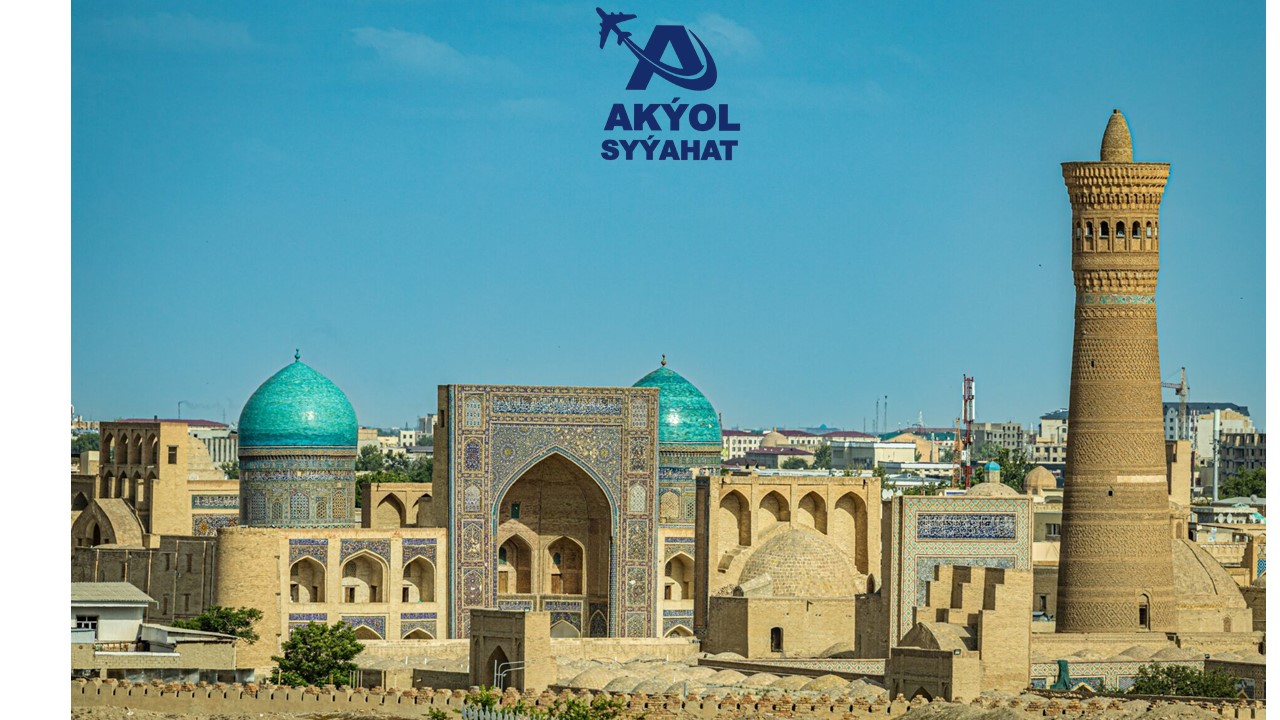
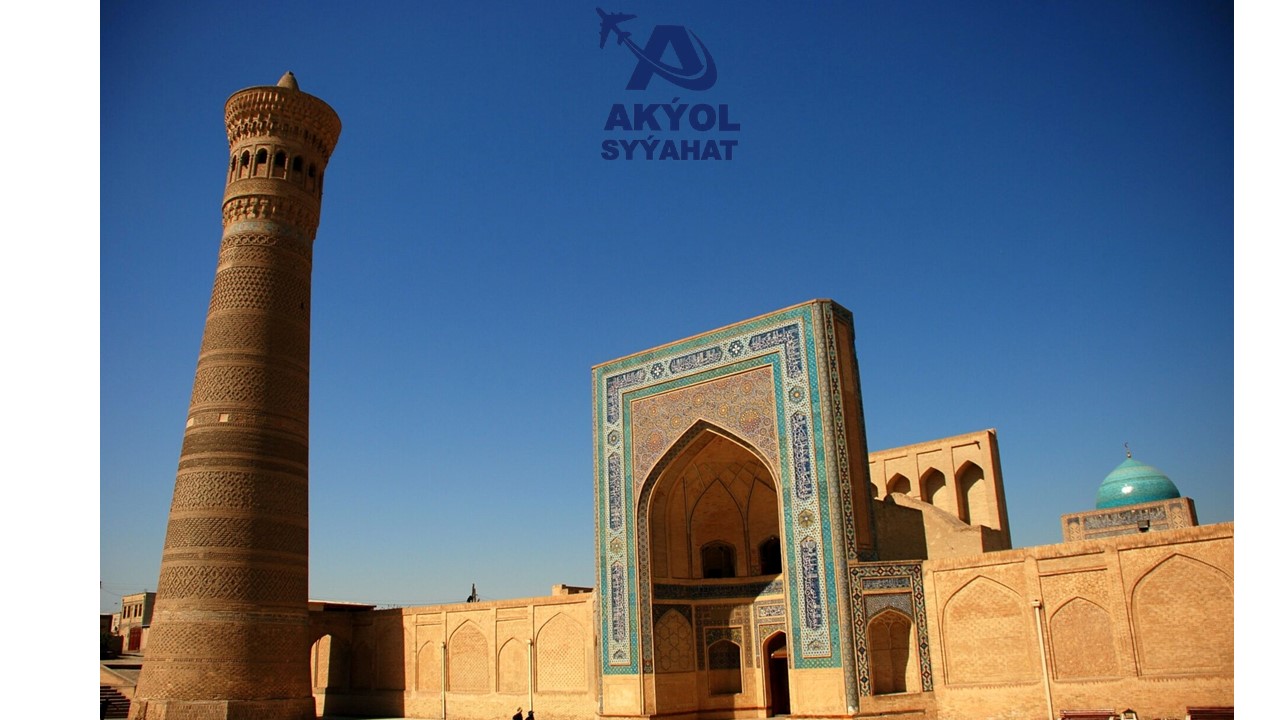
Poï Kalyan complex: It is the main ensemble in Bukhara center, situated on the way to trade crossing of "four bazars" and Poi-Kalyan means “the pedestal of the Great” (it means “the pedestal of Kalyan minaret”). Ensemble consists of 4 monuments: Kalyan mosque and Miri-Arab Madrasah – faced to each other with main fronts; between them is Kalyan minaret; to the south of Miri-Arab there is small Amir-Allimkhan Madrasah.
National dish (plov or somsa) in a national restaurant.
Overnight stay in a hotel in Bukhara.
Meals:Breakfast/Lunch/Dinner
-
09:00 start tour:
A day dedicated to continuing the discovery of the treasures of Bukhara.
Walking tour towards the Liab-i-Khaouz complex:
Nadir Divan-Beghi Architectural Ensemble consists of a madrasah, a khanaka Sufi hospice and monastery, and a hauz pond. The ensemble was constructed by order of the vizier Nadir Divan-Beghi who served for Imam Quli-Khan, one of the most powerful rulers of Ashtarkhanid dynasty. Nadir Divan-Beghi Madrasah was built in 1622. It is located in the eastern part of the Lyab-i Hauz Square.
The Magoki-Attori Mosque in the city's centre of Bukhara is an example of an urban mosque in a residential quarter. The mosque was built on the site of the pre-lslamic Moh temple mentioned above. Excavations have revealed the fact that even under the Samanids there was a six-pier mosque, which apparently was also domed. However, it was rebuilt substantially in the twelfth century; the floor level was upgraded and the main facade received a new design that survives with little damage only.
Chor-Minor madrasah speaking of the Bukhara unusual monuments, first of all, we should tell about the Chor-Minor madrasah. It is located right behind Lyabi-Khauz, in the open space. “Chor–Minor” is translated as “four minarets”. This name is well justified: the corners of the square-rectangular madrasah building are really decorated with four small minarets crowned with blue domes, different in decors from each other. Mausoleum of Ismail Samani, a pearl of world architecture;
In the evening, traditional performance in an old madrasa.
Overnight stay in a hotel in Bukhara.
Meals:Breakfast/Lunch/Dinner
-
Early departure towards Samarkand, a major crossroads of trade on the Silk Road, which reached its peak under Tamerlane (14th century), then under Ulugh Beg, his successor.
On the way, discover the:
Rabat-i-Malik caravanserai. Rabati Malik, also called Ribat-i Malik, is a caravanserai ruin located on the M37 road from Samarkand to Bukhara about a kilometer west of the edge of Malik, Navoiy Province, Uzbekistan, which was constructed along the silk road according to the orders of Karakhanid Shams-al-Mulk Nasr, son of Tamgachkhan Ibragim, who ruled in Samarkand from 1068 until 1080.
Ismail Al-Bukhari mausoleum one of the most prominent hadith scholars of the Muslim world, Imam al-Bukhari, was born in Bukhara on July 21, 810, and died in the village of Khartang (present-day Chelak district of Samarkand region), 25 km from Samarkand, where he was buried in 870. However, this place has been abandoned for centuries.
Overnight stay in a hotel in Samarkand.
Meals:Breakfast/Lunch/Dinner
-
Discovering the city, rich in numerous masterpieces of 16th and 17th century Muslim art. Here we are immersed in magnificent Samarkand; the camels laden with shimmering fabrics are no longer there, but we can easily imagine them by admiring the beautiful buildings of the past:
Registan Square, lined with madrasas with imposing portals;
Gur-e-Amir (Mausoleum of Tamerlane) one of the most significant architectural ensembles of medieval East – the Gur Emir was built in the southwestern part of Samarkand at the beginning of the XV century. This majestic complex, often featured in Uzbekistan tours, consisted of a khanaka, the madrasah of Muhammad Sultan (grandson of Amir Timur), and, later, the tombs of Amir Timur himself and his descendants.
Bibi-Khanym Mosque, the majestic blue domes of the Bibi-Khanym Mosque are the unusual sight. It takes one’s breath even from understanding the scale of construction of this monument, impressing with its size and beauty. In antiquity the dome of this mosque was compared with the dome of heaven and the arch of portal – with the Milky Way.Shah-i-Zinda necropolis, not far from Bibi Khanum mosque there is one of the most mysterious and unique architectural monuments of Samarkand, Shakhi Zinda complex. This ensemble, often featured in Uzbekistan tours, consists of rows of refined, sparkling blue tombs. Steeped in legend and harmoniously combined in a lively and moving composition, various mausoleums are grouped along the narrow medieval streets.
Valentina Romanenko Art Workshop is the quintessence of the rich experience of Samarkand masters in silk, painting and embroidery.There you can see a collection of scarves, dresses, bags and other garments made by old technologies handed down by Uzbek masters from generation to generation, watch costumed folk show and, of course, buy any dress you like.
Overnight stay in a hotel in Samarkand.
Meals:Breakfast/Lunch/Dinner
-
09:00 - continuing the exploration of Samarkand:
Hazrat-Khizr Mosque (Hazrati Khizr) is one of Samarkand’s most prominent religious landmarks. Archaeological findings reveal that in the 8th century, Samarkand’s first mosque was built on this site, which had previously hosted a Zoroastrian temple.
Remains of ancient Afrasiab and its museum the most important museum of Samarkand is the museum of Afrasiab, located directly in the center of the ancient settlement Afrasiab. Here are collected artifacts found during excavations of the city, including the famous frescos from the palace of Varhuman (650/655 - 690 years). The museum, although small, but very important - everyone who is interested in the history of Sogdiana and ancient Samarkand should not miss it.Established by the Mukhtarov brothers, the Konigil Meros Paper Factory resides in the quaint village of Konigil, a stone's throw away from Samarkand. Thanks to the brothers' dedication, they've breathed life back into the age-old tradition of paper production, using the ancestral technology of Samarkand, all of which is skillfully crafted by hand.
Remains of the Ulugh Beg Observatory (15th century) medieval Samarkand was a centre for both religious and secular learning, and his rulers patronised the sciences as well as the arts. Ulug Beg's Observatory (Tashkent; 09.00-18.00 daily), one of the largest astronomical observatories of the period, lies a brisk, ten minute walk past Afrosiab and into the foothills. 15th century observatory is the crowning achievement and path to disaster of Tamerlane's grandson, astronomer-king Ulug Beg.
Transfer to the train station to take the Samarkand-Tashkent high-speed train (Samarkand 6:00 PM to Tashkent 8:10 PM).Check-in and dinner at the hotel.
Overnight stay in a hotel in Tashkent.
Meals: Breakfast/Lunch/Dinner
-
Discover Tashkent, the capital of Uzbekistan, rebuilt after several earthquakes. Today it is a major cultural and scientific center.
A stroll through the old part of the city, a visit:
Khast-Imam Square (Hast-Imam or Hastimom), also known as Hazrati Imam, stands as the spiritual heart of the capital and ranks among Tashkent most picturesque attractions. Nestled within the old city, Khast-Imam is surrounded by historic mud-brick homes that withstood the 1966 earthquake. Exploring the Khast-Imam Ensemble is undoubtedly one of the top things to do in Tashkent.
Barakh-khan Madrasah was built in the XVI century by Suyunidzh-khan, an Ulugbek’s grandson. It is a known fact that became a location of the Spiritual Administration of Muslims of Central Asia. It is also the place where the rich library of oriental manuscripts is found. A special premise of the Barakh-khan Madrasah library is used to keep the world-known Koran of Caliph Osman. It is the primary source of holy Islam book written in the mid-VII century.
Chorsu Bazaar in Tashkent is one of the oldest and most iconic markets in Central Asia, and a must-visit destination on many Uzbekistan tours. Visiting it is one of the top things to do in Tashkent. For centuries, this vibrant trading hub has served not only as a commercial center but also as a social and cultural landmark.
Overnight stay in a hotel in Tashkent.
Meals: Breakfast/Lunch/Dinner
-
Flight from Tashkent to Fergana (07:40-08:30, approximately 1 hour).
Upon arrival and start city tour:
Akhmad Al-Fergani Park is a lush and inviting green space in the city of Fergana, Uzbekistan, offering both locals and tourists a peaceful escape in the heart of the Fergana Valley. Named after the distinguished medieval scholar and scientist Akhmad al-Fergani, the park is not only a serene retreat but also a tribute to the rich intellectual heritage of Uzbekistan. Visitors come here to unwind, enjoy nature, and learn about the city's history and cultural legacy.
Continues with a drive to Margilan (15 km/30 min), a town renowned for its picturesque market and silk production.
Yodgorlik silk factory, Margilan is one of the most ancient cities of Uzbekistan. It is situated in Fergana Valley on the intersection of ancient trade routes. The city was well known already in antiquity because it made the best silk in Central Asia, able to compete in quality and beauty with that of Chinese one. Caravans with Margilan silk tailed to Kashgar, Bagdad, Khorasan and even to Greece moving along the Silk Road.
After lunch drive to Richtan, a town renowned for its many potters.
Workshop of a famous Richtan ceramicist in the modern world craft has long given way to industrial production. Only rare oases of artisans have survived. Some work for the sake of tourists, others who are farther from civilization - for local residents.
Return to Fergana (54 km/1h20). Arrival and check-in at the hotel.
Overnight stay in a hotel in Fergana.
Meals: Breakfast/Lunch/Dinner
-
Early departure for the Kyrgyz-Uzbek border, Doslik. Completion of formalities.
Check-in at the hotel and lunch.
Discover the city of Osh, located on the Silk Road. Classified as one of the oldest cities in Central Asia and a former capital of this region, Osh is known for its bazaar, which we will visit – an ideal place to discover local life and interact with the inhabitants.
The Kurmanjan Datka Museum, located in the village of Gulcho in Osh Province and opened in 1991, is dedicated to the life and legacy of one of the most legendary figures in Kyrgyz history. Kurmanjan Datka, nicknamed the “Queen of the South”, was an outstanding leader and diplomat whose wisdom and fortitude helped protect the interests of the Kyrgyz people during the difficult period of the 19th century.
The Sary-Mogol Museum is a real gem of the Osh region, located in the picturesque village of Sary-Mogol. This ethnographic museum, founded in 1962, preserves more than half a century of history and culture of the region. The museum has about 100 unique exhibits, each of which tells its own story about the life and traditions of the people.
Overnight stay in a hotel in Osh.
Meals: Breakfast/Lunch/Dinner
-
This morning we leave Osh to take this major route which connects the south of the country with the famous Tian Chan mountain ranges in the northeast.
We're stopping:
Uzgen Bazaar (market) in Kyrgyzstan offers an authentic, traditional Central Asian shopping experience featuring famous local Uzgen red rice, fresh produce, and local, bustling trade, typically open daily from 8 a.m. to 6 p.m.
The ancient Uzgen was located on a high bank of the Kara-Darya river and consisted of three shakhristans, from which remained only hills and ruined walls. The Uzgen Minaret is vertical and consists of three parts: the lower part is an octahedron socle 5 m high; the middle part has the form of a narrowing cylinder; the upper part is a lantern built in 1923-1924 with a cupola and arched windows. The Minaret is 27.5 m high. Diameter of the lower part is 8.5 m, that of the upper part is 6.2 m.
The Toktogul Reservoir, is formed by a dam of the Toktogul hydroelectric power station on the Naryn River, in the territory of the Jalal-Abad region of Kyrgyzstan. For July 22, 2010 the volume of water made 18 billion 207 million cubic meters.
Overnight stay in a small hotel on the shores of Lake Toktogul (altitude 1000 m).
Meals: Breakfast/Lunch/Dinner
-
Road to the Suusamyr valley and passage through the Ala Bel pass (3184 m above sea level).
After visiting Uzbekistan, rich in architectural remains, you'll be treated to a feast for the eyes and the majestic peaks of the Tian Shan mountain range, including Victory Peak, which rises to over 7,000 meters! A true delight for the eyes…
A 2-hour walk in the Suusamyr valley and beautiful photos to be taken, undeniably!
Overnight stay with a local family in Suusamyr (altitude 2200 m)
Meals: Breakfast/Lunch/Dinner at local family
-
After breakfast start to the morning, the light is so beautiful in the Suusamyr valley… a moment of tranquility.
Then departure in the second part of the morning for an arrival in Bishkek in the middle of the afternoon.
A brief overview of the main sights of the capital of Kyrgyzstan, located at an altitude of 800 meters.
Overnight stay in a hotel in Bishkek.
Meals: Breakfast/Lunch/Dinner
-
In the morning, departure with all the luggage.
Visit to the very large market of Osh to buy some Kyrgyz specialties.
Then we head towards Ala-Archa (45 km/1 hour) and drop off our luggage at Nuraly's place on the way.
Hike of approximately 4 hours, including a picnic, in this mountainous valley where we will gain some altitude (2200 m).
Back to Nuraly. Final touches to the packing of the bags before the night flight.
Farewell dinner at Nuraly's.
Meals: Breakfast/Lunch/ Farewell dinner
-
Transfer to the Bishkek International Airport for flight to next destination.
- To find out about current rates and receive a personalized quote, please contact us directly.
- We will be happy
to provide you with all the information tailored to your group and dates.
Included
- Visa support, if required
- Assistance and support from the local English-speaking guides
- The visits, excursions, entrance fees to the sites, activities and shows mentioned in the program
- Ground transportation of participants and luggage, in private vehicles, throughout the duration of the tour; Airport/hotel/airport transfers;
- The train transfer from Samarkand to Tashkent
- Domestic flights: Mary to Ashgabat, Tashkent to Fergana
- Accommodation 3*,4*, camp and guest house
- Full board (breakfast/lunch/dinner) throughout the stay
- Dinner and breakfast at Darvaza Gas crater
- Sightseeing tours
- Non-alcoholic drinks, for the entire duration of the stay (1 liter of water/day/person);
- Tourist tax in Turkmenistan
- Porter services
Excluded
- International air tickets
- Insurance (non-exhaustive list: flight cancellation insurance, baggage insurance, individual insurance for medical care and repatriation, local civil liability insurance...)
- Turkmenistan visa fee 80+15 $, Migration tax 14$, PCR nose test 33$
- Personal expenses
- Alcoholic beverages
- Tips (as a guideline, a minimum of one euro per day per person for drivers, double that for guides, if you are satisfied with their services)
Additional info
PAYMENT AND BOOKING
Payment is accepted by bank transfer or cash
Once we receive prepayment of 30% from total tour price , we start immediately booking all services agreed in advance
The rest 70 % payment must be paid arrival in Turkmenistan
Customer Support
We have a professional customer support team and always accompany you on every trip.