

KAZAKHSTAN
KAZAKHSTAN
.jpg)
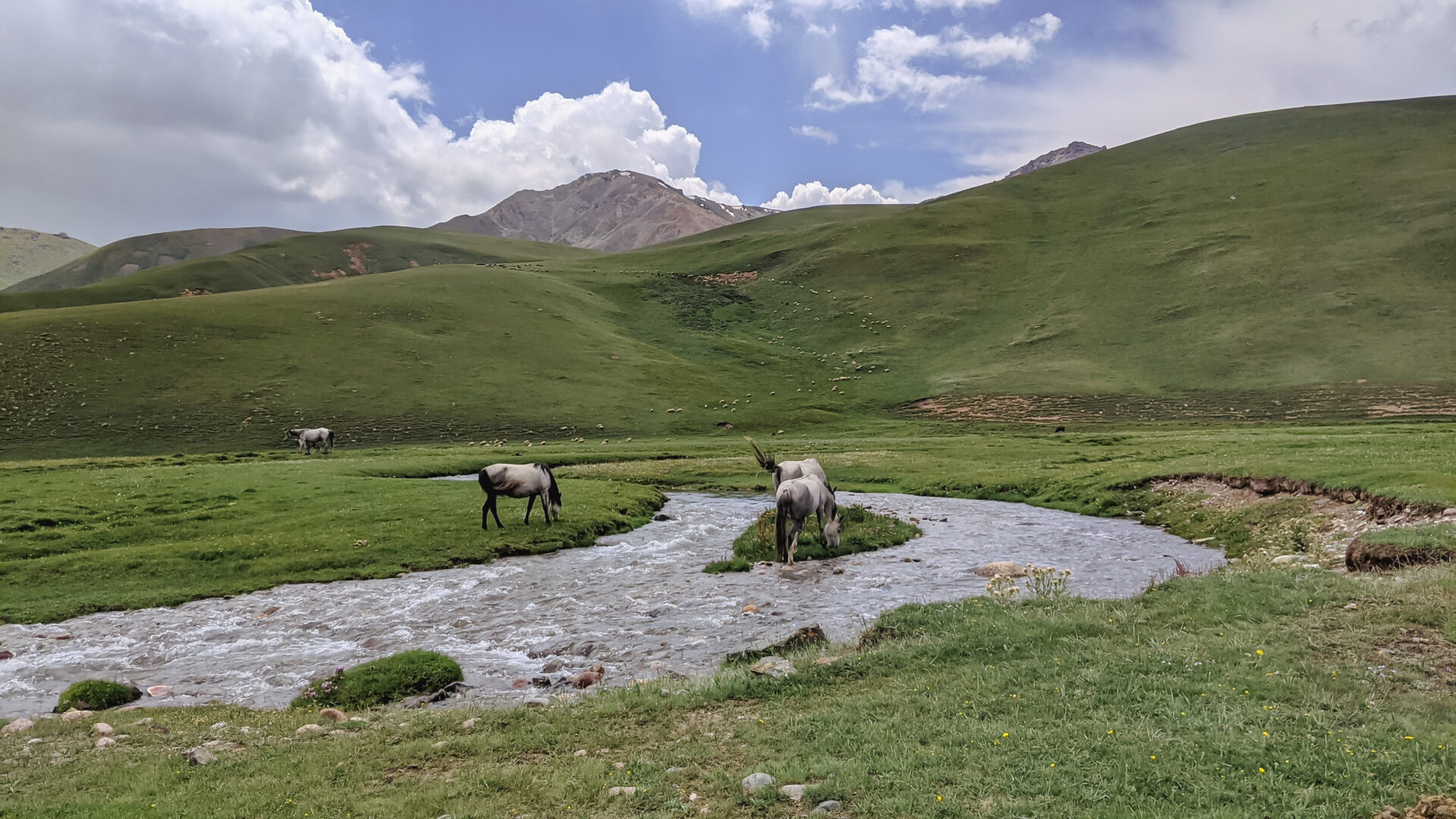
Kazakhstan, where ancient traditions and modernity coexist in harmony, is located at the center of Eurasia. The country is famous for its endless southern steppes, mountains and lakes, Baikonur Cosmodrome and the heritage of the Great Silk Road. Tourists who come to Kazakhstan will have no shortage of activities to choose from: historical trips, hunting, fishing, mountain climbing, ecotours and much more. Kazakhstan is one of the most developed countries in the post-Soviet world. The futuristic capital Astana, designed by Norman Foster and other world-renowned architects, delights the eye in its scope and structure. At the same time, travelers can discover the untouched nature of Kazakhstan’s remote regions: ancient ruins, deserts and pristine alpine landscapes.
Our Kazakhstan Travel Guide will help to acquaint you with this beautiful country.
ALMATY
Almaty is located in the southeast of Kazakhstan. Its population is 1.5 million. Although it has lost the status of capital, Almaty remains the largest financial, economic and cultural center of Central Asia. It accommodates numerous business centers, theaters, museums, art galleries, exhibition halls and countless modern entertainment complexes (ultra modern movie theaters, casinos, nightclubs, parks, restaurants, cafes and ect.)
Almaty was the capital of Kazakhstan from 1929 to 1998. It is one of the most beautiful cities in Kazakhstan with a population of 1,200,000, situated in the foothills of the Zailisky Alatau Mountains.
AKTAU
Aktau is the center of Mangistau, a desert region in southwestern Kazakhstan. This port city on the Caspian Sea is the capital of Kazakhstan's oil and gas industry and the starting point for Mangistau adventure tours. Established in the mid-20th century on barren land due to nearby rich uranium deposits, Aktau has grown into a vibrant city.
AKTOBE
Aktobe is an industrial city, and one could be forgiven for not getting particularly excited about it, being situated to the south of the southern end of the Ural Mountains, in the farthest eastern corner of Europe. Not all geographers agree just exactly where Europe's eastern limits are, but a popular argument is that they cut through Kazakhstan from Aktobe to the Emba River and then thus westwards into the Caspian Sea before passing though Azerbaijan, Armenia and Georgia en route to the Black Sea.
ASTANA
Astana, the capital of the Republic of Kazakhstan since 1997, is situated on a picturesque bank of the Ishim River. The town of Akmolinsk acquired incorporated status in 1862. It had long been famous for its fairs. Merchants from all regions of Kazakhstan, Russia and the Central Asian countries traveled here. As the development of virgin lands began, the town was renamed Tselinograd and typified the administrative center of an agricultural region. Since acquiring the status of capital the city's face has changed dramatically. The architects and builders working in the capital create wonderful architectural ensembles, which harmoniously combine modern design and oriental flair. The Baiterek Tower has become the city's symbol and its visiting card. The height of the structure is 105 meters. At the height of 97 meters there is an observation deck providing a bird's eye view of the city. The figure of 97 was not chosen at random. It symbolizes the year of the movement of the capital from Almaty to Astana. The Baiterek Tower accommodates an art gallery, a large aquarium and a restaurant.
ATYRAU
Atyrau (named Guryev during the Soviet era) is a city in Kazakhstan, and the capital of Atyrau Province. It is located 2,700 kilometers west of Almaty and 350km east of the Russian city of Astrakhan. Other transliterations include Aterau, Atirau, Atyraw, Atirav, and Atiraw.
Modern Atyrau is famous for its oil and fish industries. It has 154,100 inhabitants (2007, up from 142,500 (1999 census)), of which 90% are ethnic Kazakhs (up from 80%), the rest being mostly Russians and other ethnic groups such as Tatars and Ukrainians. Since October 2006, its mayor has been Salimzhan Naqpayev.
Climate
Climate in Atyrau is extreme continental, very hot in summer (+40oC +42oC) (104/108 F) and cold in winter (-20oC -25oC ) (-4/-14 F) Relative humidity in summer is less than 37% and in winter is around 80-84%. Atyrau is known for its strong winds and dust storms. It has an arid climate.
SHYMKENT
Shymkent is the capital city of South Kazakhstan Province, the most populated region in Kazakhstan. It is the third most populous city in Kazakhstan behind Almaty and Astana, with a population of 539,600 (as of 1 June 2007), with one of the largest metropolitan area populations in Kazakhstan. It is a major railroad junction on the Turkestan-Siberia Railway and a notable cultural center, and also has an international airport. It is situated 690km west of Almaty and 120km north of Tashkent, Uzbekistan. Shymkent was founded in the 12th century as a caravanserai (Silk Road Hotel) to serve the Silk Road town of Sayram, 10km to the east. Shymkent grew as a market center for trade between nomads and settled people. It was destroyed several times: by Genghis Khan, by soldiers from the southern Khanates, and by nomadic attacks. Once part of the Khanate of Kokand, it became part of the Emirate of Bukhara in 1810 and was then annexed by the Russian Empire in 1864. It was renamed Chernyaev in 1914 and renamed Chimkent in 1924.
TURKESTAN
The elegant decor, patterned ceiling vaults and colorful majolica tiling capture the imagination.
1500 year old Turkestan became famous, thanks to the preaching of the most famous Sufi Sheikh, the outstanding poet and humanitarian Khodja Akhmed Yassaui, also called Khazret-Sultan. At that time the city was known as Yassy.
The theological school established by Yassawi attracted those craving for knowledge, both from the neighboring cities and outlying steppes of Kazakhstan. The city became the most significant center of enlightenment in Kazakhstan. The memorial complex which developed on the grave of the great Yassawi, turned into one of the most visited places of worship in Central Asia.
In the late 14th c. Turkestan acquired a unique structure - a large complex centered around the Mausoleum of Khodja Akhmed Yassaui, built by the Great Timurlane. In the Muslim World, Khodja Akhmed Yassaui Mausoleum is considered to be a "second Mecca".
The height of the huge building, which has witnessed many historical disasters and was opened recently after a restoration, is about 40 meters. The mausoleum is a marvelous complex of palaces and temples. It has over 30 rooms and halls; diameter of the main dome is 22 m. Its elegant decoration, patterned ceiling arches, and color mosaic majolica look stunning. In its central hall, the covered residence of the Kazakh Khans, has been opened a peculiar museum - the pantheon. The pearl of its exposition is the Kazan, the biggest cast water vessel throughout the Muslim East. It was made of the alloys of seven metals.
The Azret-Sultan historical and cultural reserve includes Turkestan and Kultobe cities, a necropolis, mausoleums (15th-17th cc.), Dzhuma mosque (19th c.), restored Big Hilvet (12th с.), chilakhana (room for rituals and prayers) (14th c.), bath-house (17th-19th cc.) and a fragment of the original citadel wall (19th c.) with gates (18th-19th cc.).
Out of the 802 historical and cultural memorials of South Kazakhstan region, 528 are monuments of archaeology, 42 historical monuments, and 226 architectural monuments.